
Bat Houses
Bee Houses
Bird Feeders
Bird Houses
Bluebird Houses
Wren Houses
Butterfly Houses
& Feeders
Ladybug HousesHummingbirds
Jabebo Earrings
Accessories
BirdSong IdentiFlyer
Show Schedule
International Orders
Bird Facts
Bird Feeding
About Me
Wholesale
Contact Us
Custom Houses
Customer Feedback
 |
Northern Cardinal
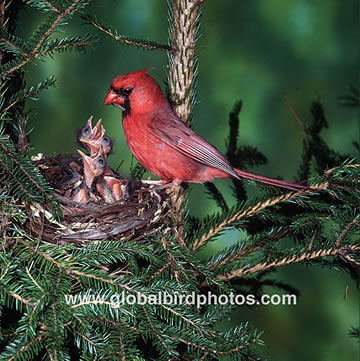
Photo courtesy of Global Bird Photos
The brilliantly colored Northern Cardinal has the record for popularity as a state bird: in the United States, it holds that title in seven states. This common bird is a winter fixture at snow-covered bird feeders throughout the Northeast, but it only spread to New York and New England in the mid-20th century.
Medium-sized songbird.Large crest on head.
Heavy, conical red bill.
Face surrounded by black.
Male entirely brilliant red.
Female grayish-tan with red tail and wings.
Size: 21-23 cm (8-9 in)
Wing span: 25-31 cm (10-12 in)
Weight: 42-48 g (1.48-1.69 ounces)
Song a series of clear whistles, the first down-slurred and ending in a slow trill. "Cheer, cheer, cheer, what, what, what, what." Call a sharp "chip."
- Population density and range of the Northern Cardinal has increased over the last 200 years, largely as a response to habitat changes made by people. However, it is listed as a species of special concern in California and may disappear there because of habitat loss.
- The female Northern Cardinal sings, often from the nest. The song may give the male information about when to bring food to the nest. A mated pair shares song phrases, but the female may sing a longer and slightly more complex song than the male.
- The male cardinal fiercely defends its breeding territory from other males. When a male sees its reflection in glass surfaces, it frequently will spend hours fighting the imaginary intruder.
- Brighter red males hold territories with denser vegetation, feed at higher rates, and have greater reproductive success than duller males.
This information was gathered from the Cornell lab of Ornithology.
 indicates that this product is custom hand crafted at time of order.
Home | Bird Houses | Bird Feeders | Bat Houses | Butterfly Houses | Bird Facts | Bird Feeding | Contact Us | About Me